
Slip! Slop! Slap!
The Sound of Public Trust


Hello, and welcome to Animated, a weekly dose of animation, gift-wrapped for you to share with friends and family. This week, I have been delving deep into a piece which I hope will bring some joy to your Sunday. My newsletter is free, but if you like what you read and feel the urge to support it, coffee helps keep the research flowing.
Slip! Slop! Slap!
A seagull in board shorts tap‑dances across the screen, cheerful and unbothered, singing a tune so light it barely feels like instruction. The words bounce, the rhythm sticks, and before you’ve had time to question it, the message is already lodged in your head. Slip. Slop. Slap.
First broadcast in Australia in 1981, Slip! Slop! Slap! was created by Cancer Council Victoria in response to soaring rates of skin cancer in a country defined by sun, beach, and outdoor life. The science was clear that ultraviolet radiation caused damage to the skin. Melanoma was rising. But knowledge alone wasn’t changing the behaviour of the Australian public.
Like many other animated public service campaigns, it didn’t argue; it sang and came up with something memorable for children and adults. It would have a ripple effect on the present and future generations.
Sid the Seagull doesn’t warn you about death or disease. He doesn’t show burnt skin or hospital wards in any graphic detail, as everything is softened through animation. Sid doesn’t even mention cancer until the very end; instead, he models the behaviour people should adopt to protect themselves. He slips on a shirt, slops on sunscreen and slaps on a hat. The actions are so simple, almost playful, and crucially, they feel very Australian.
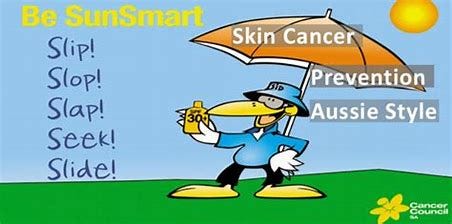
This matters, I think, because earlier public information films often worked by interrupting. Slip! Slop! Slap! works by joining what you need to do together. It doesn’t challenge beach culture, rather it embeds itself within it. Sid belongs at the seaside as he looks like everyone else. He’s not an authority figure or an outsider, he’s just… sensible.
Animation is doing subtle yet heavy lifting here. Sid’s movements are exaggerated enough to be memorable, but not so cartoonish that they feel unreal. His body language is relaxed, and his song is upbeat. The sun is bright but not threatening. Nothing in the frame tells you that something is wrong, and I think that that’s the brilliance.
The Slip! Slop! Slap! campaign understands that sun exposure isn’t as dangerous as crossing the road might be. It’s more of a background condition, so you don’t react to it like a fire or a stranger; it’s something you live with, and so the solution isn’t a warning; it’s a routine.
This campaign didn’t teach Australians to fear the sun. It taught them to dress for it and, over time, the slogan became part of the language. Children repeated it in school, then parents enforced it without thinking. Hats became normal as sunscreen became expected. What began as a jingle became muscle memory, and, like many public information campaigns that used animation, it endured.

Throughout the 1980s, variations of the ad aired nationally. Sid gained friends. Sunglasses appeared, and shade was added. In 2007, the message expanded to Slip, Slop, Slap, Seek, Slide, reflecting updated medical advice while keeping the original rhythm intact.
That continuity is rare, as many campaigns fade because they are tied to a sense of urgency. Slip! Slop! Slap! endured because it was tied to daily life.
Looking back now, it’s tempting to see the campaign as obvious. Of course, you wear a hat and use sunscreen, but that normalisation is a real achievement. Before Slip! Slop! Slap! Sunburn was common, even expected.
Statistically, its impact is complex. While melanoma rates rose among older Australians who grew up before widespread sun safety education, incidence among younger generations has dropped significantly since the 1990s, a change widely associated with long‑term sun protection messaging.
But culturally, the impact is clearer as Slip! Slop! Slap! succeeded because it didn’t demand sacrifice, and it didn’t frame protection as a loss of pleasure. It simply reframed what being outside looked like. The beach didn’t change, the behaviour did.
Placed alongside the other figures in this series, Sid the Seagull occupies a unique space.
Tufty taught rules. Charley taught awareness. Bert taught reflex. McGruff taught responsibility. The House Hippo taught doubt.
Sid teaches care — without fear.
He shows that prevention doesn’t have to be grim. That public health messages can be light without being trivial, and that sometimes the most effective instruction is the one that feels like a song you’ve always known.
Slip. Slop. Slap. You don’t remember learning it. You remember doing it.
Thanks for reading Animated. If you feel that someone else might like to read it, please feel free to share. Thank you.
Brilliant roundup - I've really loved this series! :)
Aussies are really good at this sort of PSA-style campaigning. I’m an American who grew up in Australia, and there’s a history to this success: When I was a kid in the early ‘70s, the country began an aggressive (not forceful - educative) program to gradually introduce the metric system, in what was planned as a 10 year or so campaign to convert the nation to the system. It worked; Australia might be the only predominantly English-speaking country that has fully, and successfully, gone metric. The TV ads were simple and spot-on. and they did the job without any obvious fuss.
Similarly, in the ‘80s and into the ‘90s, a campaign was launched against driving under the influence. The slogan?
“Drink and drive. Bloody idiot.”
There were billboards and posters for these everywhere, in addition to TV spots.