
Paddington Bear: a small bear with very big manners
When Paddington stepped beyond animation and into the national imagination


I am writing about Paddington as a late Christmas gift to my lovely wife. She has always been a fan and has her own Paddington from her childhood that our children have played with. She isn’t a big animation fan, but always finds time for a slice of the marmalade-loving bear that is Paddington. This, I hope, will mean I don’t get the Paddington stare.
Where Paddington began
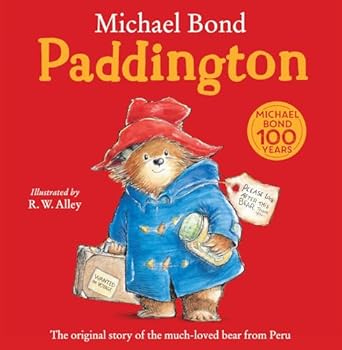
Paddington Bear first appeared in 1958. He arrived not with a roar but with a note neatly tied around his neck.
Created by Michael Bond, Paddington was inspired by a lonely teddy bear Bond spotted on a shelf in Selfridges on Christmas Eve. The image stuck: a small creature, far from home, waiting patiently to be taken in.
That sense of displacement is woven into Paddington from the start. He is a bear from darkest Peru, who is sent to London by his Aunt Lucy, armed with a battered suitcase, a love of marmalade, and an unfailing belief that people will generally do the right thing.
A Bear Called Paddington introduced readers to a character who wasn’t magical; rather, his power lay in politeness, curiosity, and the gentle chaos that followed him everywhere.
Bond famously resisted over-explaining Paddington’s origins. Paddington worked because he felt real: a little lost, very sincere, and always trying his best.
Paddington, the on-screen bear
Paddington’s move into animation and television came swiftly. In the late 1960s, a series of animated television shorts appeared, using a distinctive visual approach of mixed media limited animation. Paddington himself was animated in a simple, sketch-like style, while the world around him was often static or minimally detailed.
This was not a budgetary compromise so much as an artistic choice. Paddington’s slightly unfinished look made him feel fragile and hand-drawn, a look that has been maintained in part. It suited him.
Unlike many animated characters of the time, he didn’t dominate the frame. He occupied it, politely.
Later television adaptations in the 1970s and 1980s moved further into narration, often using Michael Hordern’s warm voice. These versions positioned Paddington almost as a listener’s companion rather than a star.
You didn’t watch Paddington so much as you were allowed to spend time with him.
A character who evolves without ever changing
What is remarkable about Paddington is how little he has fundamentally changed. Whether across books, animation, television, and film, his core traits remain intact: politeness, optimism, and a tendency to misunderstand the world in ways that reveal its absurdities to us.
Yet his context has evolved, for example, in the books, Paddington’s London is post-war and gently chaotic, full of small rules and quiet rituals. In later screen adaptations, the city becomes brighter, faster, and more diverse. Paddington adapts, not by changing who he is, but by applying his same values to new situations.
That adaptability is why the leap to modern cinema worked so well.
The leap to film, and unexpected success
When Paddington arrived in cinemas in 2014, expectations were cautious.
Talking-animal films have a mixed track record, and Paddington’s charm is subtle. But the film was an absolute triumph.
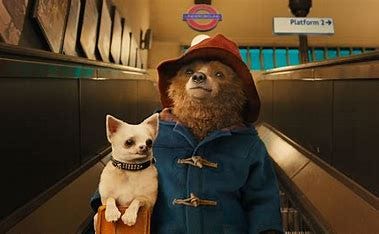
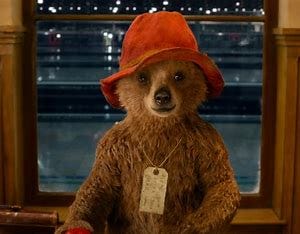
Ben Whishaw’s soft voice performance captured Paddington perfectly, while the decision to set the story in a recognisably British live-action London grounded it. Crucially, the film understood that Paddington is not funny because he’s silly, he’s funny because he’s sincere in a world that often isn’t.
The sequel, Paddington 2 (2017), went further, earning extraordinary critical acclaim and cementing Paddington as a modern cultural figure rather than a nostalgic relic. It’s a message that kindness can be radical, felt timely, without being preachy.
A third film, Paddington in Peru, has since confirmed the character’s continuing relevance, taking him back towards his origins while keeping his London-found family firmly intact.
Paddington as a cultural figure
Paddington occupies a unique space in British culture. He’s not mischievous like Dennis the Menace, or fantastical like many characters. Paddington is about manners, but not stiff ones; his politeness is active. It’s something he does, not something he expects from others.
Paddington’s status as a national figure was perhaps most clearly underlined during the London 2012 Olympic opening ceremony, where he appeared opposite Queen Elizabeth II in a short filmed sequence.
He wasn’t used for irony or nostalgia; he was presented simply as unmistakably British. This was a moment that quietly confirmed, for me, what many already felt: Paddington had moved beyond children’s animation and into the cultural fabric itself.
Children see a bear navigating a confusing world. Adults see an outsider trying to be good amid mild hostility, bureaucracy, and social awkwardness. It’s no accident that Paddington has often been read as a metaphor for immigration, hospitality, and what it means to belong.
The famous image of Paddington sitting on a bench beside the Queen during the Platinum Jubilee was not ironic. It was deeply appropriate. Paddington represents a version of Britain that likes to believe in itself.
Money, marmalade, and longevity
Financially, Paddington has been a quiet powerhouse. Michael Bond’s books have sold tens of millions of copies worldwide and have been translated into dozens of languages. The film franchise has now grossed hundreds of millions globally, with strong returns in the UK and Europe.
Other merchandising has always been steady rather than aggressive: plush toys, books, clothing, and limited-edition collaborations. Paddington isn’t overexposed. His brand value comes from his core values, too.
Advertising tie-ins have been carefully chosen, often focusing on warmth and reassurance from brands, with Paddington being rarely used to sell something he wouldn’t plausibly approve of. That restraint matters.
Three things you might not know about Paddington
First, Paddington was initially intended as a one-off character. Michael Bond only wrote a second book because readers asked for more.
Second, Paddington’s iconic duffle coat and hat were practical decisions. They are easy-to-understand visuals that made him instantly recognisable, especially in illustration and animation.
Third, Paddington’s politeness is not a weakness. In many stories, it’s the thing that exposes other people’s bad behaviour without Paddington ever having to comment on it.
Why we adore Paddington
Paddington endures because he offers a version of goodness that isn’t naïve; he gets things wrong and causes problems, but never stops believing that people are worth the effort.
In animation and screen culture, where loudness often equals importance, Paddington’s quiet persistence is radical. He doesn’t demand attention. He earns it.
Like the Grinch, Paddington tells us something about ourselves. I think that where the Grinch asks whether we can let go of resentment, Paddington asks something perhaps a little more challenging: can we be kind without mistaking it for weakness, open without being overwhelmed, and polite without being passive?
For a small bear with a suitcase and a sandwich, that’s quite some legacy.
Keeping politeness in mind, I have been having a rethink over the last few weeks and have decided to no longer offer a paid option. I love researching and writing my weekly post, and I want to share it to ignite a love of animation.
May your 2026 be fun-filled loveliness.
I have always loved Paddington. Great write-up, Jon!
I've loved Paddington since childhood and even had one of my own which is in terrible shape from being almost loved to death. While I am a fan of the older shorts from the 70s and the 80s specials, I could never bring myself to watch the more recent movies. That incarnation of Paddington quite frankly borders on Uncanny Valley and gives me the creeps. 😬