
Mary Poppins: When Animation Behaved Itself…OK mostly.
'I'd recognise that silhouette anywhere.'

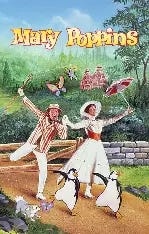
Welcome back to Animated, where this week I’ve been looking at another moment in animation’s long flirtation with live‑action. So, if The Three Caballeros was Disney throwing paint around to see what would happen, then Mary Poppins is the studio knowing it could also tidy its brushstrokes without losing its sense of play.
This is the film most people think of when they imagine live‑action actors stepping into animated worlds and looking like they belong there. It is certainly more polished, more controlled, far more British, and infinitely more ‘family Christmas on the BBC’, but underneath the tidiness, it’s still quietly experimental, as I always like to think that Mary Poppins behaves herself, but the magic never does.
A film that looks orderly, but was born from creative turbulence
Released in 1964, Mary Poppins sits in that sweet spot between Walt Disney’s most refined era and the end of his personal creative oversight. It’s a film made when the studio was fully confident in its tools, whether it be the story, music, performance, or animation.
While The Three Caballeros wandered wherever it pleased, Mary Poppins is very much a constructed world. Everything is placed, timed, and measured, which makes the moments when animation interrupts the real world feel deliberate rather than chaotic, which really enhances the film for all ages.
It is this controlled environment that, for me, allows the magic to feel like magic instead of noise. When Mary, Bert, and the children step into a chalk painting, it’s not a technical demonstration; it’s an invitation into a world that’s been gently waiting for them.
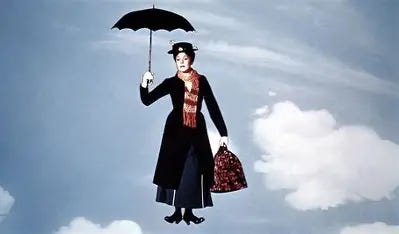
Julie Andrews, Dick Van Dyke, and the confidence to treat animation as a partner
Mary Poppins is poise; Julie Andrews’ performance is incredibly self‑assured that the animation feels like an extension of her authority, as if she wills it into existence without being phased by the penguin waiters, the carousel horses or the pastel countryside. It feels like that stillness of hers is important to what is happening around her.
Dick Van Dyke, meanwhile, does the opposite. He delights in the animation as though he can barely believe it’s happening to him. He treats the penguins like old pub mates and dances as if the animators are trying to catch up. I must say I love his accent throughout the film; we even still quote him in our house.
The joy of these sequences comes from the artists animating alongside the actors, not despite their presence, which Disney has excelled in with its innovation.
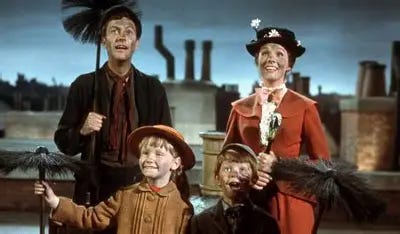
Live‑action and animation share the same breath.
Technically speaking, Mary Poppins is far cleaner than its predecessors, but what makes it significant isn’t the composite parts in the film but rather its tone.
The chalk‑pavement world feels airy and light. The penguin sequence in particular works because the animation doesn’t fight the performers’ physicality; the penguins glide, dart, and pause with the kind of timing you’d normally reserve for a dance routine. There’s just a confidence here that Caballeros didn’t have time to develop.
Mary Poppins is experimental, certainly, but it’s a film that whispers… “This is extraordinary, but of course it is, Mary is here.”
Disney’s house is finally in order
Where Caballeros behaves like a jazz improvisation, Mary Poppins is more like a perfectly orchestrated medley. Every animated flourish has an intention behind it, such as the chalk world, which has a palette that looks hand‑selected for storybook gentleness.
The animated animals have personalities that feel grounded rather than abstract. It feels like where Disney had learned restraint, not limitation, just restraint with animation becoming the supporting actor, not the headline here.
And that’s why it works so enduringly well, sitting inside the story, not beside it.
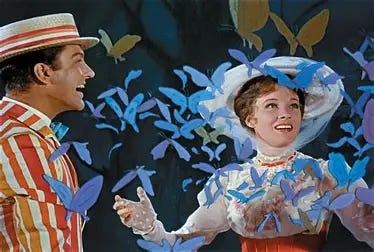
Cultural Context
Mary Poppins is unmistakably British in tone; there’s a tidy, wallpapered domesticity to it, a belief that wonder can exist politely within set boundaries, but the film also understands something beautiful: that imagination is often most powerful when it appears in small, controlled doses.
Magic tidies the nursery. Magic turns a trip to the park into an escape. Magic lets a chimney sweep dance with cartoon penguins but still be home for tea.
It’s a fantasy that respects structure, and I would argue that’s what makes it so comforting.
Why it still matters
Mary Poppins is remembered for its seamless feel, but I think it matters because it represents Disney at its moment of perfect self‑awareness. The studio finally understood how to blend magic with narrative discipline, and it discovered how animation can enhance characters rather than overshadow them.
For animation historians, this is Disney proving it could innovate without chaos. For casual viewers, it’s simply delightful. For me, it’s the point where animation became trustworthy, not because it behaved, but because the filmmakers knew exactly when to let it misbehave.
Three Fun Facts
1. The penguin scene took months of hand‑drawn animation for just seconds of screen time
Those cheerful little waiters weren’t rotoscoped or simplified: Disney’s animators drew them traditionally, frame by frame, to match Dick Van Dyke’s loose footwork. It’s a tiny sequence in the film, but it required an absurd amount of labour, and the animators later joked it was like ‘teaching a penguin to tap dance backwards in time.’
2. Julie Andrews won an Oscar for a role Walt Disney had been chasing for nearly 20 years
Walt had been trying to acquire the rights to Mary Poppins since the 1940s, but P. L. Travers refused repeatedly. By the time she finally said yes, Andrews was still a newcomer to film but went on to win the Best Actress award for her role.
3. The famous Step in Time rooftop dance used clever camera tricks to hide impossible choreography
The chimney sweeps’ leaps, spins and near‑misses were so demanding that parts of the set had hidden supports and soft platforms disguised as rooftops. Van Dyke was known for performing ‘as if gravity is optional’ improvised portions that forced animators to adjust timing in the later effects shots. The whole number looks effortless, but it wasn’t.
Wrapping it all up
Mary Poppins is Disney at its most organised, but not its most predictable, carrying the experimentation of the early years while framing it with elegance. It just knows when to let animation sing, and when to let it hum quietly in the background.
I hope that you enjoyed this dance through Mary Poppins. As ever, thank you for reading, and if you think someone else would like to read, feel free to share it.
Dick Van Dyke's British accent is legendary 👌 😄
A unique way of looking at a unique film.