
Down in Fraggle Rock
A look at Jim Henson’s quietly revolutionary world beneath our feet

Welcome to Animated, a weekly publication exploring animation, craft, and the ideas behind how things are brought to life. If that sounds like your kind of thing, feel free to subscribe or follow.
This week, I take a look at the puppet side of animation - Fraggle Rock!
A Brief History
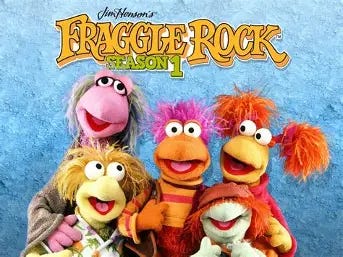
Fraggle Rock first aired in 1983 and ran until 1987, spanning five series with almost a hundred episodes. The show was, of course, created by the one and only Jim Henson and was designed as a truly international production, co-produced and broadcast across multiple countries simultaneously, which even now still feels ahead of its time.
At its centre, this was not just another children’s television show with puppets. Henson had a very clear aim: to create a series that could explore conflict, misunderstanding, and community, all within a playful, musical world.
Unlike The Muppets, which leaned heavily into sketch comedy and performance, Fraggle Rock built a fully realised ecosystem. A layered one. Almost quietly political, of course, if you choose to see it that way. It also had one foot in live action and the other in puppetry, combining both worlds seamlessly and brilliantly. The human ‘outer space’ sequences, featuring Doc and his dog Sprocket, grounded the show, but it is what happens beyond the wall that people seem to really remember.
Premise
The world of Fraggle Rock exists just out of sight in a hidden network of caves and tunnels beneath the human world. Here live the Fraggles: curious, energetic creatures who spend their time exploring, singing, and, more often than not, misunderstanding everything around them as their lives blend with two other key groups.
The Doozers, small industrious builders, who spend their days constructing intricate structures… which the Fraggles then eat, seeing them as food rather than architecture.
And towering over both are the Gorgs. These were large, blustering creatures who consider themselves rulers of the universe, largely because no one has told them otherwise. It sounds chaotic, and it certainly was, but there’s a clear rhythm to it. Each group believes it understands the world correctly, but none of them does.
The Fraggles
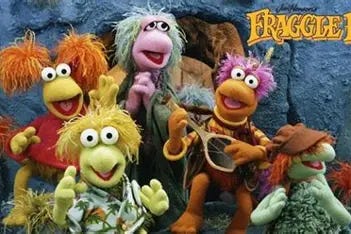
Gobo, the adventurous one, leads the group not by authority but by curiosity. His expeditions are often guided by postcards from ‘Uncle Travelling Matt’ in the human world, which push the others into new situations.
Red Competitive, energetic, always ready for a challenge. Red’s enthusiasm is infectious, even if her certainty sometimes leads her into trouble.
Wembley was permanently undecided. Wembley is the embodiment of indecision, but also the heart of the group, being open, kind, and often more perceptive than he realises.
Boober Cautious, anxious, convinced the worst would happen. He was usually wrong but not always.
Mokey Finally, Mokey was the dreamer, artistic and introspective. Mokey often sees connections that the others miss.
The decision to build a world
Where Fraggle Rock differs from many other puppet-based shows is in its commitment to world-building. This wasn’t done as a backdrop, as in other shows; it really created the entire world.
Every element feeds into another. The Fraggles eat the Doozers’ constructions. The Doozers need to build. The Gorgs believe themselves to be rulers of everything below. And the Fraggles fear and occasionally steal from the Gorgs. It always seemed like a loop of misunderstanding that somehow functions.
For me, that’s the brilliance. It doesn’t present harmony as natural. It is much more accidental, fragile, and often maintained through misinterpretation rather than understanding, but it still works, OK, most of the time,
Music as storytelling
Like much of Henson’s work, music isn’t an addition, as every episode features songs that aren’t just there to entertain, but to reinforce the narrative cleverly. They explain emotions and misunderstandings, and occasionally resolve conflicts.
Why does it still reverberates
Researching Fraggle Rock now, it feels oddly modern. Not really the look, as the puppetry is of its time. The modern feel came from groups living alongside each other, each convinced they’re right.
In the world we live in now, it can be full of sharper messaging and clearer moral lines, but Fraggle Rock feels content to sit in ambiguity. To say: things are complicated, people (and creatures) misunderstand each other, but connection is still possible.
Animation and beyond
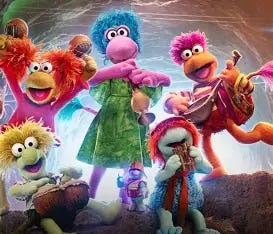
Though not an animation in the traditional sense, Fraggle Rock occupies a similar creative space. I think that this is because the puppetry, set design, and camera work combine to create the illusion of a living, breathing world.
The show has continued to exist through reruns, home releases, and more recently, revivals and streaming adaptations, but the original remains the most compelling.
Fun Facts
Fraggle Rock was one of the first television series designed for global co-production and distribution, with different countries filming their own ‘Doc’ segments to localise the show.
Jim Henson created the series to promote peace and understanding between cultures.
The caves and sets were designed to give a sense of depth, making the Fraggle world feel much larger than it actually was.
Do they still matter?
It would be easy to see Fraggle Rock as a nostalgic relic. Bright puppets, catchy songs, a simpler time, but that undersells it for me, as what I really like to think is that it offers something more enduring, like a reminder that different worlds can coexist, even when they don’t fully understand each other. Harmony isn’t that neat in my opinion.
I was an avid Muppets fan, so always saw this as less engaging than that (probably because I was a bit older), but your facts are fascinating. I never realised the complexity or messaging behind the show. Also: I now have you to thank for having the catchy theme tune in my head...
I don't think I ever saw Fraggle Rock, but you make me want to go and find it. A world of parallel lives seems especially relevant (they ate the architecture!).