
Who Framed Roger Rabbit: When Animation Refused to Behave at All
I’m not bad. I’m just drawn that way.

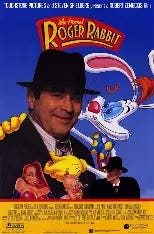
I am continuing this week with my look at animation and live action, and this is one of the craziest links in this series, I think.
Welcome to Animated, where this week I’ve been looking at the moment when animation didn’t politely step into the real world, didn’t wait for permission, and certainly didn’t wipe its feet. Who Framed Roger Rabbit is an animation kicking the door open and demanding to be taken seriously.
Who Framed Roger Rabbit?
This is the film people point to when they talk about seamless blends of live‑action and animation, but that description almost undersells it. Roger Rabbit doesn’t just blend worlds; it insists they were always meant to coexist, however uncomfortable that might be.
A film that looks anarchic, but was engineered with frightening precision. Released in the late 1980s, Who Framed Roger Rabbit arrives at a moment when animation was seen as nostalgic at best and disposable at worst. Disney itself was wobbling, unsure of its identity and future, and quietly looking back for reassurance.
And yet, what we get here is not comfort; it almost feels like a confrontation to me.
The world of Roger Rabbit is chaotic, noisy, morally slippery, and deliberately unstable. Toons don’t behave like guests in a human film, but they interrupt and collide, then leave a mess behind them. The remarkable thing is that every piece of this apparent madness is tightly choreographed. This might all feel wild, but that is only because the animators wanted it to be.
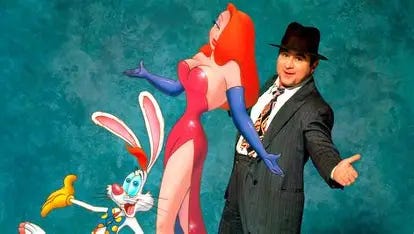
Bob Hoskins and the act of believing in the impossible.
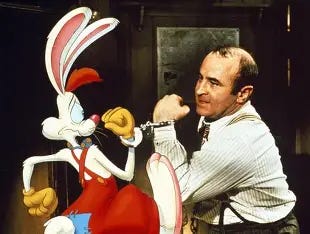
Bob Hoskins’ performance as Eddie Valiant might be the single most important ingredient in making this film work. He doesn’t acknowledge the joke; he reacts to Roger Rabbit as if this absurd, rubber‑limbed creature has ruined his life in very real ways.
Hoskins gives the animation weight, and his physical commitment is astonishing, especially when you remember Hoskins was often acting against air, tape marks, or nothing at all.
By contrast, Roger himself is pure chaos. He’s desperate to be loved, terrified of being forgotten, and incapable of staying still long enough to be safe. Where Mary Poppins commands animation with calm authority, Roger Rabbit is barely keeping up with his own existence.
For me, it is the tension between grounded human exhaustion and animated hysteria that drives the entire film.
Ahead of its Time
Live‑action and animation share the same danger. Technically speaking, Roger Rabbit is leagues beyond what came before it, but again, that’s not why it lingers. What makes it extraordinary is that animation isn’t treated as a mere decoration. It’s dangerous because the toons can be hurt, erased, or even die.
I think that the film noir setting matters here. This is a hard‑boiled detective story in which animation isn’t an aside but a marginalised underclass, boxed into Toontown and treated as property. The jokes land because the stakes are real, and the laughs sting because they’re sitting next to something genuinely unsettling.
The film’s style draws from everywhere. It has Disney softness, Warner Bros. aggression, Tex Avery elasticity and then somehow forces them into the same frame.
It’s a film that understands animation history deeply enough to parody it without mocking it. The cameos aren’t gimmicks; they’re declarations. These characters exist as they always have, but now they’re standing in the same light as the humans who created them.
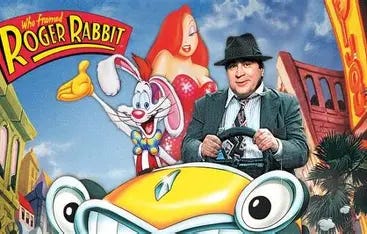
Cultural Context
Who Framed Roger Rabbit is soaked in nostalgia, but it isn’t sentimental. It seems to be a version of Hollywood as corrupt and deeply cynical, where toons are stars one minute and disposable labour the next.
Beneath the slapstick, the film is about the erasure of communities, art forms, and histories deemed inconvenient. Animation here becomes a metaphor for creativity itself: loud, unruly, difficult to control, and constantly under threat from systems that prefer clean lines and predictable outcomes.
Why it still matters
Who Framed Roger Rabbit matters because it proved animation could carry tone, theme, and adult complexity without losing its identity. It sits nicely in history for its technical and artistic high points, and it really is endlessly entertaining.
Three Fun Facts
Bob Hoskins reportedly bruised his ribs during filming
Hoskins threw himself into scenes with such physical commitment that he often collided with invisible co‑stars at full force. He later joked that Roger Rabbit was the most demanding actor he’d ever worked with, and the only one who didn’t apologise.
Every animated character obeys real‑world lighting rules
Animators painstakingly matched shadows, reflections, and light sources so that toons would feel physically present. That’s why Roger feels like he’s actually in the room rather than pasted on top of it.
The film quietly saved feature animation.
The success of Roger Rabbit helped reignite industry confidence in animation as a medium, paving the way for a creative resurgence that followed soon after.
Wrapping it all up
Who Framed Roger Rabbit reminds us that animation is here in all its forms and can be bold and brash without losing sight of its brilliance.
Thank you, as always, for reading. If you enjoyed this journey into Toontown, feel free to share it with someone who still believes in the power of cartoons.
This is a great film as a story in it's own right. Yet when you think of it on a technical level, it really floors me. Having to use imagination, puppetry, then physically draw and paint over film to hide the artifice and make it look seamless, it's a wonder it works at all.
I also remember the amazement of seeing competing cartoon characters in the same space, you'll never see Disney and Warner Bros characters talking to each other again.
It's always great for me to revisit this, thanks!
Although I didn't love this film, I did love your piece on it! I hadn't really thought how difficult it must've been to act with animation, but have a new-found respect for Hoskins!