
Toy Story 2: The sequel that sharpened Pixar’s edge
'The important thing is that we stick together.'

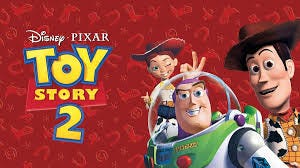
This week is part II of my look at the giant that is Toy Story, with its sequel, Toy Story 2, which introduced new characters and had to be completed at a breakneck pace.
Origins and milestones
Toy Story 2 didn’t begin life as the big-screen juggernaut audiences remember. Disney first commissioned it as a direct-to-video follow-up while the main Pixar crew were busy finishing A Bug’s Life. Once the story reels started to sing, Disney upgraded it to a cinema release, which created a frantic pivot at Pixar. John Lasseter then returned to the director’s chair, with Ash Brannon and Lee Unkrich alongside, and the team rebuilt the film’s story in an incredibly compressed nine-month schedule. Much faster than the usual Pixar’s multi-year gestation. The U.S. release was on 24 November 1999, following an El Capitan cinema premiere earlier that month.
The production also produced one of animation’s most infamous war stories: a catastrophic file deletion during 1998 that wiped vast swathes of the movie directly from Pixar’s servers. Salvation arrived via supervising technical director Galyn Susman, who, working from home with a new-born baby, had an almost current copy on her personal machine. Back up, back up, back up!
How the sequel levelled up the craft
For me, technically, Toy Story 2 is a conspicuous step up from Toy Story. Advances in shading, texturing and character rigs gave the toys more subtle expressions and fabric that looked woven rather than painted on. Wired’s set visit pieces from late 1999 noted how the team re-lit and re-shaded legacy characters, including Woody’s denim, to stand comfortably alongside newcomers like Jessie, while pushing creature work, such as Buster the dog, far beyond 1995 standards.
Voices & Music
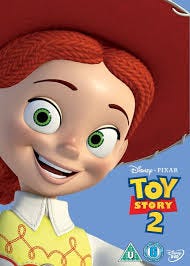
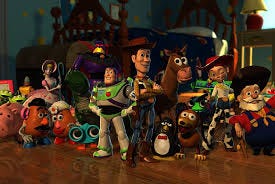
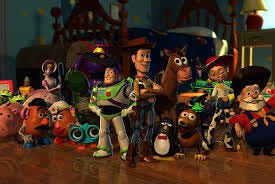
The returning ensemble—Tom Hanks (Woody), Tim Allen (Buzz), Don Rickles (Mr Potato Head), Jim Varney (Slinky Dog), Wallace Shawn (Rex), John Ratzenberger (Hamm), Annie Potts (Bo Peep)—were all joined by Joan Cusack (Jessie), Kelsey Grammer (Stinky Pete), Wayne Knight (Al McWhiggin), Estelle Harris (Mrs Potato Head) and Jodi Benson (Barbie).
Randy Newman returned to score, with Sarah McLachlan performing When She Loved Me, Jessie’s quietly devastating backstory ballad, later a Best Original Song Oscar nominee and Grammy winner. The film itself won the Golden Globe for Best Motion Picture, Musical or Comedy.
The characters - The Toy-Box is reopened.
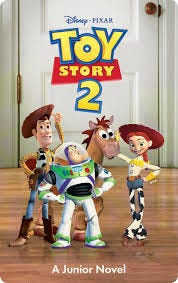
Woody remains the loyal, wry moral centre; Buzz is the earnest do-gooder (with a slice of identity confusion when he meets Utility Belt Buzz); Jessie injects a different dimention and athleticism with a tender core with Bullseye who shows a devotion; Stinky Pete is the velvet-voiced villain who would rather be a museum piece than a child’s companion; and Al the grasping collector whose ‘chicken suit’ is almost as memorable as his garage-sale ethics. These archetypes — devotion, identity, and belonging — are deliberately broad and play beautifully in animation.
Story threads
Beyond the famous airport-luggage climax, the sequel sharpens the series’ central tensions: toys are meant to be played with, not preserved; friendship which triumphs over status; and immortality in a glass case isn’t living. The film flips Toy Story’s existential anxieties, Buzz’s ‘am I a toy?’ becomes Woody’s ‘what’s my purpose as a toy?’—and fuses silliness (Zurg’s I am your father sequence) with poignancy (Jessie’s montage). I would suggest that this is a masterclass in family storytelling: clear stakes, character-based gags, and an emotional truth children recognise and adults feel.
Pop culture ripples
Pixar helped popularise mid-credit ‘blooper’ reels; Toy Story 2’s were so well loved they were added to prints on Christmas Day 1999. Two decades later, one faux outtake—Stinky Pete’s ‘casting couch’ gag—was removed from new home releases and streams in the #MeToo era, a rare but needed example of legacy content being updated to reflect shifting norms. The film also rode the early-2000s 3D conversion wave in a cinema double feature with Toy Story (2009) and has since received a 4K UHD upgrade, too.
Advertising appearances
The franchise has long embraced cross-promotion. In late 1999, McDonald’s ran a sizeable Toy Story 2 Happy Meal line across the U.S., a classic movie tie-in. Years later, in the UK, Woody and friends fronted a Sky Broadband campaign tied to the Toy Story of Terror! Extraordinary—evidence that the characters’ advertising power extends well beyond toy aisles.
Spin-offs and related work
Buzz Lightyear of Star Command: The Adventure Begins (2000) kicked off a Disney Television Animation series expanding Buzz’s pulp-sci-fi exploits. After Toy Story 3, Pixar returned to the gang in Toy Story Toons—Hawaiian Vacation and Small Fry (2011), then Partysaurus Rex (2012)—plus two TV specials, Toy Story of Terror! (2013) and Toy Story That Time Forgot (2014). On the games front, Toy Story 2: Buzz Lightyear to the Rescue! (1999/2000) turned the film’s rescue mission into a well-liked platformer on PlayStation, N64, Dreamcast and PC. Merchandising has been relentless.
What the numbers say
Against an estimated $90 million budget, Toy Story 2 grossed around $487.1 million worldwide across releases, including $245.9 million in the U.S., making it a resounding commercial success that also helped cement Pixar’s brand as a byword for quality. The 2009 Toy Story/Toy Story 2 3D double feature added a further $35.9 million worldwide.
Fun Facts
Geri—the elderly chess-player from Pixar’s Oscar-winning short Geri’s Game—is the meticulous cleaner who restores Woody, a cheeky studio crossover.
The animation file-deletion saga prompted Pixar to overhaul backup and restore practices—an industry cautionary tale.
In December 1999, Disney added the blooper reel as a mid-credits sequence, a then-novel way to send families out smiling.
Conclusion
As a piece of cinema craft, Toy Story 2 is the platonic ideal of a sequel: bigger action (the luggage-system set-piece), richer character work (Woody’s temptation, Jessie’s history), and technical evolution that supports the story rather than upstaging it. As intellectual property, it proved that the toys were more than a one-off novelty; they could carry shorts, specials, games, and even advertisements, remaining relevant for decades with fresh cinematic adventures.
As a cultural artefact, it quietly asked a universal question in between the jokes: what are we for, if not to be loved and used well? That’s quite a tall order for a 92-minute family film, and exactly why, all these years later, its plastic heart still beats.
Loved this follow-up piece on the sequel. Such iconic films. Thanks : )