
The Three Caballeros
When Donald Duck stepped into the real world

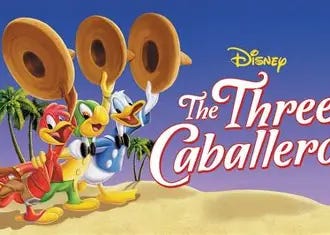
Welcome to Animated, where this week I have been investigating the blend of live-action and animation. For the next few weeks, I will be researching and writing about these delights of animation for your wonderment. This week, one that is sometimes overlooked but predates the classic Mary Poppins, The Three Caballeros is where Disney really learned how to let animation and live action dance together, sometimes literally.
This is Donald Duck at his strangest, cinema at its loosest, and animation briefly throwing the rulebook out just to see what would happen.
A film born of circumstance and curiosity
Released in 1944, The Three Caballeros arrived during a peculiar moment in Disney history as World War II had reshaped the studio’s output into propaganda films. Budgets were tighter, and traditional feature-length narratives were temporarily replaced by so‑called ‘package films’, which are collections of shorter segments loosely held together by a framing idea.
On paper, that might sound like a compromise, but when you look a little deeper, it permitted Disney to experiment.
Donald Duck receives birthday gifts from friends: a projector, a pop‑up book, and a piñata. Each gift opens a door into a different animated vignette, introducing us to José Carioca and Panchito Pistoles, and eventually to something far more daring: animated characters openly flirting, dancing, and interacting with live-action performers.
There is very little plot urgency here, and that is entirely the point; it was an experiment in animation and what it could achieve.
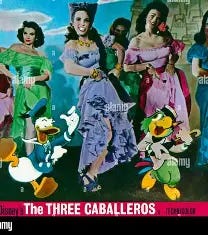
Donald Duck, unleashed.
For me, Donald is an interesting choice as an anchor, but I guess Mickey would never work here as he is seen as being too polite, too symbolic, and, more importantly, too carefully managed. Donald, on the other hand, is just chaos in a sailor shirt.
In The Three Caballeros, Donald is impulsive, curious, and perpetually overwhelmed by colour, rhythm, and possibilities, and this shows throughout.
What I enjoy most is how unguarded he feels, away from the restraint of typical animation. This isn’t the short‑tempered comic foil of earlier cartoons, nor the softened corporate mascot he would later become; rather, this is Donald as pure animation, where he is reactive, excitable, occasionally inappropriate, and endlessly watchable.
José and Panchito aren’t sidekicks so much as accelerants. They don’t rein Donald in; they encourage him.
When animation meets flesh and blood
The film’s most historically significant contribution is also its most surreal: animated characters sharing space with real humans in a way that feels playful rather than technical.
Aurora Miranda dances with Donald. Live‑action performers acknowledge cartoons as physical presences. Perspective appears to bend, and gravity gives up, but the camera doesn’t flinch.
Unlike later films, this isn’t about realism. No one is trying to convince you that Donald truly exists in the same way Bob Hoskins later would in Who Framed Roger Rabbit?. Instead, the film invites you to accept animation as a guest in the real world without any real explanation and for me, this confidence matters.
The Three Caballeros is significant in animation, as without it, we might not have had Mary Poppins, Pete’s Dragon, Bedknobs and Broomsticks, or, heaven forbid, Who Framed Roger Rabbit?
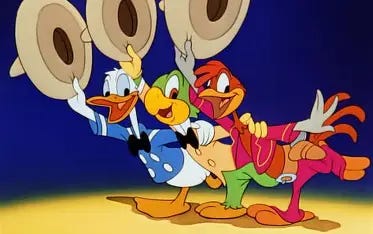
Style over structure, and proud of it
If you’re looking for narrative discipline, this is not your film; The Three Caballeros is closer to a jazz album than a three‑act story, where sequences drift, songs interrupt themselves, and the film pauses to admire colour, texture, movement, and rhythm.
Visually, it’s one of Disney’s boldest films of the era, without a doubt. Psychedelic flourishes creep in years before the 1960s get the credit, along with abstract shapes, exaggerated motion, and musical timing that dominate. It’s not subtle, and again, that’s the point. Disney was being unleashed from wartime constraints, and this feels like it is stretching its legs.
Cultural context, gently handled
It’s impossible to ignore that the film was produced as part of the Good Neighbour Policy, which aimed to strengthen relations between the United States and Latin America. There is idealisation here, simplification, and a distinctly American lens.
That said, the film’s tone is celebratory rather than patronising. Music, dance, and local flavour are foregrounded with genuine enthusiasm. It’s less a lecture than a love letter, which is broad, imperfect, yet sincere.
And, importantly, Donald is the outsider. He’s the one trying to keep up.
Why it still matters
The Three Caballeros doesn’t endure because it’s tidy or narratively perfect; I think that it endures because it captures animation mid‑experiment, before best practice hardened into a formula that all the studios can use.
It shows a studio learning how much freedom animation really has, how elastic reality can be, how joy can be structured enough for audiences to enjoy.
For animation historians, it would be called a hinge point.
For casual viewers, it’s a colourful oddity.
For me, it’s a reminder that progress often arrives disguised as play in animation.
Sometimes, the most important step forward is simply letting cartoons step outside the frame and see what happens.
Final thoughts
This is not Disney at its most polished, but I would argue that it is Disney at its most curious.
Donald Duck, dancing with humans in animation, refusing to stay in its lane, and briefly remembered in cinema, can be strange.
And that, I think, makes The Three Caballeros not just a precursor to greater things, but a quietly radical moment in animation history.
Next time, animation gets a little more orderly - Spit Spot.
I have never heard of this one! But loved your introduction to what sounds like a colourful affair :)
This project was preceded by the similar "Saludos Amigos", which, in addition to Latin-flavored animation, has footage of Walt Disney himself and his animators taking in South America.