
First Big Break: Chuck Jones with What's Opera, Doc? (1957)
The move to Master Craftsman

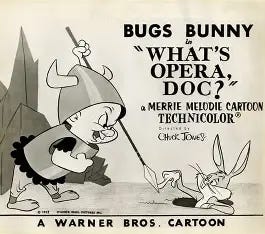
First Big Break: Chuck Jones — What’s Opera, Doc? (1957)
Welcome to my second article in the Big Break series. Last week it was the turn of Miyazaki, this week it is the turn of Chuck Jones. Over the next few weeks, there will be other legends in animation and their very own big breaks, which I hope you enjoy reading about.
Chuck Jones had been making great cartoons for years. By 1957, he was already responsible for some of the most precise, psychologically sharp work at Warner Bros. He had refined the personalities of Bugs Bunny, Daffy Duck, and Wile E. Coyote. In my opinion, at this stage, he understood timing better than almost anyone in the business, knowing exactly how a gag should land and, more importantly, when it shouldn’t.
It is with What’s Opera, Doc? that I think the skill stops being seen as craftsmanship and starts being recognised as authorship.
Released in 1957, What’s Opera, Doc? is a seven‑minute Merrie Melodies short directed by Jones and written by Michael Maltese. On paper, it’s familiar territory: Elmer Fudd hunts Bugs Bunny. Disguises, pursuit, reversal, which was a structure that was almost ritualised by this point.
What changes here is how seriously the cartoon takes itself.
The short reimagines the Bugs–Elmer dynamic as a full Wagnerian opera, borrowing extensively from Der Ring des Nibelungen and Die Walküre. Dialogue is sung, and motifs recur as it commits to the operatic form, not as a throwaway joke, but as its fundamental role.
Jones had already explored classical music before in the Rabbit of Seville (1950) is the obvious predecessor here but What’s Opera, Doc? goes further. The visual design is stark and monumental. Maurice Noble’s layouts replace slapstick clutter with vast, graphic spaces and the backgrounds by Phillip DeGuard’s certainly evoke stone, sky, and myth. Movement slows here, letting emotion really come through.
As you can imagine, this was a risk, as at this time Warner Bros. cartoons were expected to be fast, funny, and disposable. Jones deliberately stretched production time, pouring far more labour into this short than was standard. He also went into detail studying ballet dancers for accuracy and letting musical sequences unfold with almost no gags at all. Still, the amazing thing is that Bugs Bunny belonged here.
That’s the quiet provocation at the heart of the film. What’s Opera, Doc? doesn’t mock high culture from the outside. It treats Wagner with just enough respect to reveal his excesses, and in doing so, it elevates the cartoon form itself, and this is where Jones becomes an auteur.
Not because he suddenly gains a voice, but because he uses the full language of animation through music, design, timing and performance to make a point about its capacity. The short insists that cartoons can critique cultural forms without losing their identity.
The final image of Elmer mourning Bugs’s apparent death, only for Bugs to break the fourth wall and ask, “Well, what did you expect in an opera? A happy ending?” really hits home, not as a gag, but as a statement.
Over time, What’s Opera, Doc? became one of the most celebrated animated shorts ever made. In 1992, it was selected for preservation in the U.S. National Film Registry and was the first animated short to receive that recognition, cited as “culturally, historically or aesthetically significant.” - (chuckjones.com)
After What’s Opera, Doc?, Jones is not just a director within the system. He is talked about as a singular creative presence, and his style becomes identifiable.
Not coincidentally, I think, this is also when Jones’s work becomes harder to categorise. Duck Amuck, One Froggy Evening, and What’s Opera, Doc? form a loose trilogy of self‑aware, formally ambitious shorts that investigate cartoon itself, its rules, its illusions, and its emotional reach.
For me, it proves that a cartoon can parody high culture and aspire to it, along with showing that seven minutes is enough time to do something complete.
Placed alongside the other “first big breaks” in this series, Jones’s moment is distinct.
Miyazaki’s break creates a studio.
Jones’s break redefines a form.
It doesn’t lead to institutional control; rather, it grants permission for animation to be read seriously, without ceasing to be funny.
That permission still matters because every time a cartoon slows down, holds a pose, trusts the audience, or reaches for something larger than the gag in front of it, it’s working in the space What’s Opera, Doc? carved out.
Seven minutes, no safety net, and the moment everyone realised cartoons could do more than anyone had asked them to.
Thanks for reading. If you liked what you read, feel free to share the love.
Gosh this is ingrained deep in the memory. Off to see if I can find it on YouTube. Great analysis Jon, it’s a really bold and interesting crossover that certainly had a lasting impact. I can’t get over that it was only 7 minutes, felt much longer (in a good way 😂).
Fascinating stuff! I haven't seen this, but it sounds like such an interesting way to blend cultures.