
Bedknobs and Broomsticks and the Confidence of Imperfect Magic
How Disney’s most eccentric live‑action hybrid embraced animation, artifice, and imagination during a moment of transition.

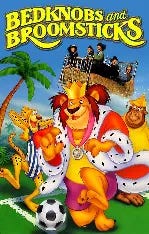
Welcome back to Animated, where this week I’ve been revisiting another chapter in animation’s ongoing courtship with live action, this time with a film that feels slightly more eccentric, slightly more threadbare, and, for me, all the more interesting for it. If Mary Poppins is Disney with its house in order, then Bedknobs and Broomsticks is the studio realising that order can slip, wobble, and still hold together through sheer charm.
This is a film that often lives in the shadow of its predecessor, remembered more vaguely, spoken of more gently, yet it carries a real, strange confidence. It is certainly messier, odder, far less polished and most definitely a long film. I like to think that Bedknobs and Broomsticks doesn’t glide into magic with its animation, but rather it trips over it, rights itself, and carries on anyway.
A film stitched together from imagination and necessity
Released in 1971, Bedknobs and Broomsticks arrived at Disney during a period of transition. Walt Disney was gone, the studio was recalibrating, and the certainty that had powered earlier films was being replaced by experimentation born of uncertainty. I think this matters because you can feel it in every frame.
Where Mary Poppins feels architected, Bedknobs and Broomsticks feels more assembled, not carelessly but assembled all the same. The film leans on ideas, reuses techniques, and embraces seams, letting them show.
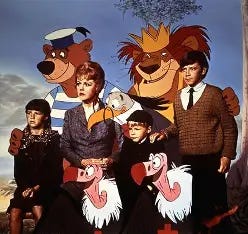
For me, that openness becomes part of the magic. The animation doesn’t quietly support the story; it seems to barge in, announce itself, and dares you to keep up. When Angela Lansbury’s Eglantine Price steps into animated space, it doesn’t feel like a technical flourish; it feels more like the film admitting that imagination is doing the heavy lifting here, and proudly so.
Angela Lansbury and the authority of believing in nonsense
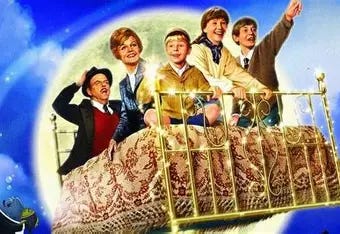
Angela Lansbury carries this film with a performance that treats the absurd as a professional obligation. Her Miss Price doesn’t question the magic around her; she studies it, practises it, and occasionally grows irritated when it doesn’t behave. That seriousness gives the animation something solid to lean against. You may guess here that yes, I was a big Angela fan.
Unlike Julie Andrews’ serene command, Lansbury’s magic feels earned through effort. She works at it, and because of that, when animated creatures enter the frame, whether they are football-playing animals or exaggerated fantasy landscapes, they feel like part of her agenda, rather than a surprise.
David Tomlinson’s Professor Browne, meanwhile, reacts as though the animation has caught him unprepared. He blusters, protests, and adjusts his dignity around it, and that tension between belief and disbelief gives the animated sequences their humour throughout. The joy comes not from pretending animation isn’t there, but from acknowledging it loudly and constantly.
Live action and animation refuse to behave.
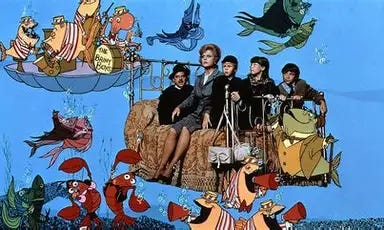
Technically, I’d be the first to admit that Bedknobs and Broomsticks is less refined than Mary Poppins, but it makes up for it with personality. The animated island of Naboombu is lush, exaggerated, and unapologetically cartoonish. Perspective bends, physics relaxes, and movement is deliberately brilliant.
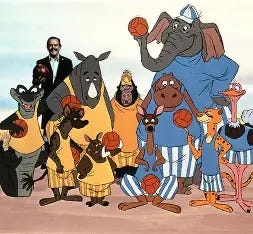
The famous football match works because the animation isn’t trying to be subtle. The animals move with broad gestures and expressive timing that feels closer to classic shorts than feature-length restraint. They don’t blend into the live action here; they clash with it, and the film seems to delight in that friction.
There’s an honesty here. Animation isn’t pretending to be real, and live action isn’t pretending to be magical. They meet in the middle, agree to suspend disbelief, and carry on.
Disney’s structure loosens, but imagination expands.
If Mary Poppins is a perfectly orchestrated medley, then Bedknobs and Broomsticks is a patchwork overture. Ideas overlap, tones shift, and the film occasionally feels like it’s chasing itself, but that looseness allows animation to stretch out and play.
This is where the film becomes quietly brave. It doesn’t apologise for its rough edges. Instead, it leans into them, trusting that imagination can fill the gaps where precision falls away.
There’s something unmistakably post-war British about Bedknobs and Broomsticks. It’s a film about resourcefulness, about making do, about turning everyday objects into tools for survival, practical magic.
A bed becomes transport. A spell becomes defence. Animation becomes a way to externalise imagination in a world that feels uncertain. The fantasy doesn’t escape reality; it supports it.
This is a story where wonder exists alongside ration books and air raid sirens, and that grounding gives the animation weight, plus you get a splash of Bruce Forsyth for good measure.
Why it still matters
Bedknobs and Broomsticks matters because it captured Disney in motion, figuring itself out in real time. It shows a studio willing to reuse, remix, and reimagine its tools rather than endlessly polish them.
For animation historians, it’s a fascinating transitional artefact. For casual viewers, it’s eccentric and charming. For me, it’s a reminder that animation doesn’t need perfection to feel magical, it sometimes just needs confidence in its own strangeness.
Three Fun Facts
Much of the animation was repurposed from earlier Disney projects
The Naboombu sequence famously reuses animation created for Snow White and other features. Rather than feeling lazy, it creates a strange sense of familiarity, as though Disney’s past is quietly in its present.The film won an Academy Award for its visual effects
Despite its rougher reputation, Bedknobs and Broomsticks won the Oscar for Best Visual Effects in 1971, a recognition of the ambition of its blend of live action and animation.Angela Lansbury performed many scenes against minimal reference
Lansbury often acted with little more than floor markings and direction, relying on timing and imagination to sell interactions with animated characters that wouldn’t exist until much later.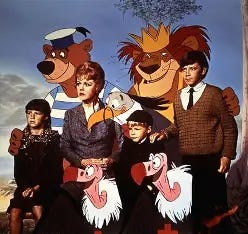
Wrapping it all up
Bedknobs and Broomsticks isn’t Disney at its most refined, but it might be Disney at its most revealing. It shows what happens when animation is allowed to be slightly unruly, when structure loosens, and imagination takes the lead.
I hope you enjoyed this wander through broomsticks, footballing animals, and quietly stubborn magic. As ever, thank you for reading, and if you think someone else would enjoy it, feel free to share it.
David Tomlinson's presence in both "Poppins" and "Bedknobs" is a more subtle linkage between the two films. (Browne was originally to have been played by Ron Moody, but he backed out). In the former film his character doesn't interact with the animation at all (and his stuffiness wouldn't have allowed him to accept it as real), but in the latter he does...
This film was made in the period between Walt's 1966 death (as you noted) and Michael Eisner's mid-1980s arrival, and the corporatization of the company that followed. Besides the animated films they were playing it safe with rather mundane things like the Herbie and Medville College series films and one-off comedies like "The Boatniks" and "Gus", barring the more experimental feel of 1982's "Tron". In essence it was a time when the studio was running in place, a ship without a secure captain to guide it.
Great article! One of my favorite movies growing up.